
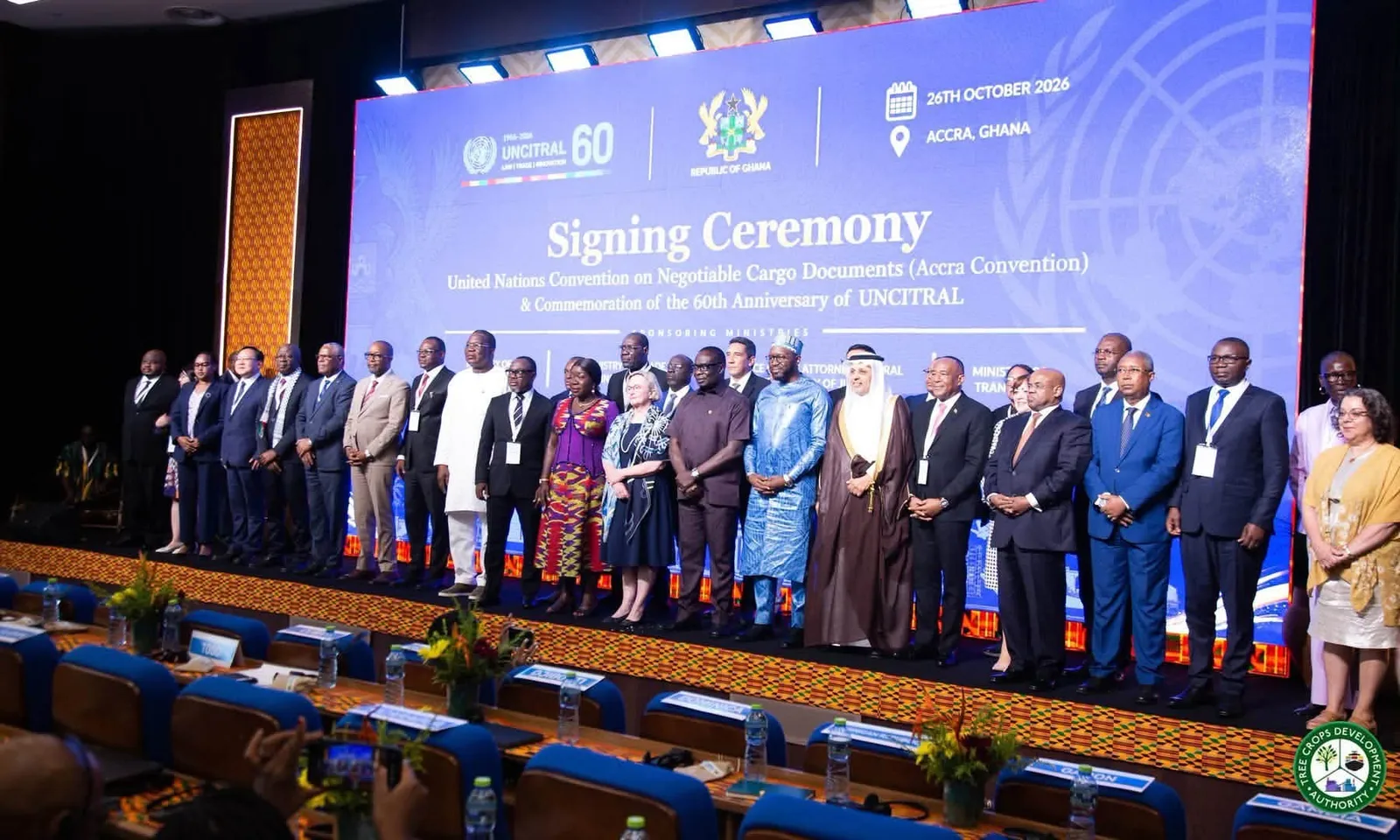
Ghana has taken a significant step towards modernising international trade following the signing of the United Nations Convention on Negotiable Cargo Documents, popularly known as the Accra Convention, in Accra on October 26, 2026.
The ceremony brought together government officials, diplomats and representatives of international organisations to advance efforts to simplify cargo documentation, improve cross-border trade and promote digital transformation in global supply chains. The event also coincided with the 60th anniversary of the United Nations Commission on International Trade Law (UNCITRAL).
The gathering featured the Minister for Trade, Agribusiness and Industry, Elizabeth Ofosu-Adjare, alongside other government representatives and stakeholders in Ghana’s trade and transport sectors.
A new framework for digital cargo documentation
The Accra Convention establishes a harmonised legal framework for negotiable cargo documents in both paper and electronic formats. It covers goods transported by road, rail, air and sea, allowing businesses to benefit from a more consistent system for documenting and transferring rights to goods in transit.
According to UNCITRAL, the Convention is intended to facilitate trade finance, support the sale of goods while they are in transit and improve the efficiency of multimodal transport. It also provides for a single negotiable cargo document to cover an entire journey involving different transport modes.
The development addresses a longstanding challenge in international commerce: dependence on paper-based documentation, which can increase administrative costs, delay transactions and complicate the movement of goods across borders.
By providing legal recognition for electronic negotiable cargo documents, the Convention could help businesses exchange trade documents more efficiently and improve coordination among exporters, transport operators, financial institutions and other supply-chain participants.
What it could mean for Ghanaian agriculture
For Ghana’s agricultural export sector, the Convention presents an opportunity to improve the movement of commodities from farms and processing centres to international markets.
Exporters of cocoa, cashew nuts, shea products, fruits and other agricultural commodities often depend on several actors to move goods from their points of origin to ports and overseas destinations. Documentation requirements across these stages can add to costs and create delays.
A more streamlined cargo documentation system could help exporters reduce paperwork, improve the transfer of information and make transactions more predictable. Electronic negotiable cargo documents could also provide new opportunities for traders to use goods in transit to support financing arrangements, subject to the Convention’s requirements and the applicable domestic legal framework.
These possibilities could be particularly relevant to small and medium-sized agricultural enterprises, which may face difficulties accessing affordable trade finance and navigating complex export procedures.
However, the extent of the benefits will depend on how effectively the Convention is implemented, the readiness of financial institutions and logistics operators, and the ability of agricultural businesses to adopt digital systems.
Supporting regional and international trade
Ghana’s hosting of the signing ceremony also reinforces the importance of trade facilitation under the African Continental Free Trade Area (AfCFTA).
A harmonised approach to cargo documentation could help reduce legal and administrative barriers affecting cross-border trade, particularly where goods travel through several countries or combine different modes of transport.
The Convention could therefore contribute to more efficient regional supply chains and strengthen opportunities for Ghanaian businesses seeking to reach markets across Africa and beyond.
The signing ceremony marked an important milestone, but the agreement’s practical impact will depend on the next stages, including ratification and implementation. Ghana’s Trade Minister has indicated that the government intends to initiate the necessary domestic legal processes to bring the country’s laws and systems into alignment with the Convention.
From signing to implementation
The Accra Convention is a step towards a more digitally enabled trading environment, but signing alone will not eliminate the challenges facing exporters.
Effective implementation will require legal reforms, coordination among public and private institutions, reliable digital infrastructure and awareness among traders and logistics providers. Training and accessible systems will also be important to ensure smaller agricultural businesses can participate in the transition.
For Ghana, the priority will be to translate the international agreement into practical improvements that reduce trade costs, facilitate financing and help exporters compete more effectively in global markets.
As the country advances its digital trade agenda, an important question remains: Can the Accra Convention help Ghanaian farmers and agricultural exporters move their products to international markets faster, with less paperwork and better access to finance?
The answer will depend on how quickly the new framework moves from an international commitment to everyday practice across Ghana’s agricultural value chains.